I’m writing this post from Saanich inlet, a place that’s in many of my stories, whether I name it or not. We’ve moved back to the west coast, and it’s strange how quickly Ontario has fallen away from me. We’ve been here a little more than a month, and in that time I’ve had moments of uncanny recognition, so intense they’re almost painful: in the drizzle, eating a spartan from the tree by the door while smoke from the chimney drifts down; low tide in the rain; cedar sawdust from the planer in my hair and eyes and down the back of my shirt (and in my socks); blackberries in sunshine; arbutus bark curling down to the forest floor; rain on the roof and waves on the gravel below the bedroom window.
Most of the stories I have written in the last ten years have been about exile and distance and leaving places behind. I wonder what I’ll write now that I’ve come back?
And in a nice synchronicty, my first collection of short stories is forthcoming from Stelliform Press. It was a struggle to select which stories, to find some kind of through-line across genres and eras. It starts in the past and ends in the future, and each story touches upon the place where I’m writing this: the north Pacific coast of North America. The Salish Sea. Home.
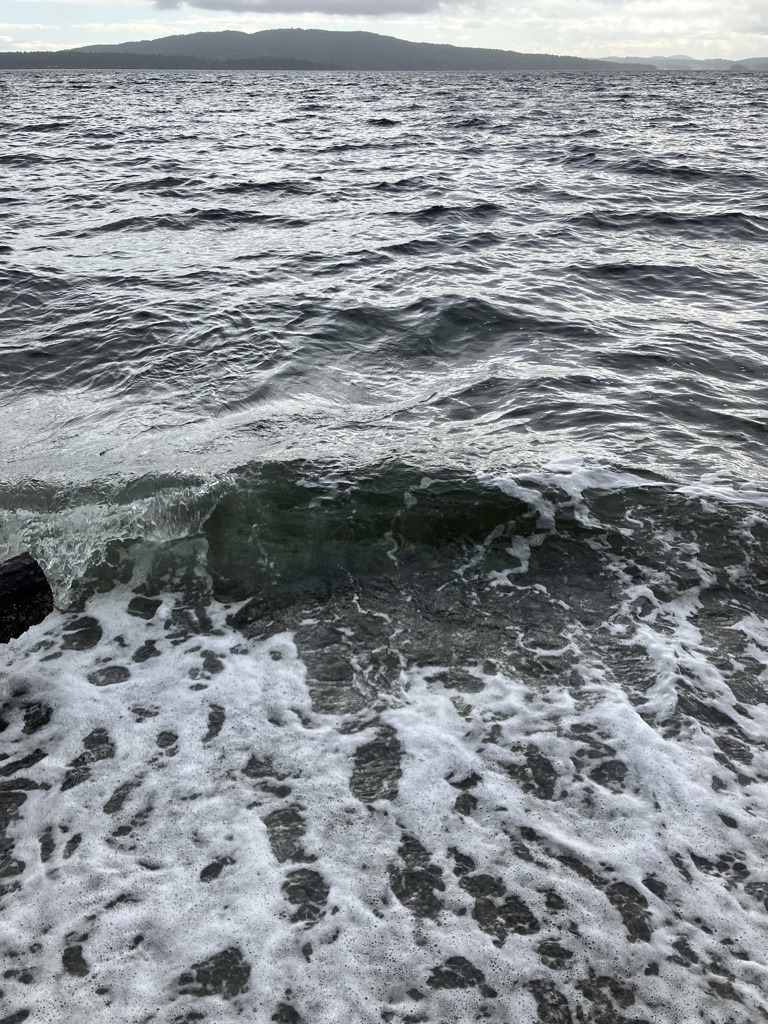
I keep taking pictures of beaches. I can’t help it. It’s in my nature.
I haven’t kept a good record here of what’s happening with books. I missed posting about The Talosite‘s publication last autumn, and about appearing at GritLit in spring, or about how Arboreality was nominated for the Philip K Dick Award in January (it didn’t win). But right now. Arboreality is one of nine books on the shortlist for Ursula K. le Guin Prize, and it has not yet not-won (the ceremony is in October).
It will surprise no one that Ursula le Guin is a huge part of my mental landscape, up there with Twin Peaks and Middlemarch and all the Tennyson lyrics I still have memorized. It’s not even about having a “favourite author” so much as it’s the two-by-fours that make up the walls of your brain, or the concrete underneath those walls. Her work is foundational. And now a book of mine is in this tiny way associated with her. It seemed important to write that down in public and remember it.
So, my 2019 story “The Fourth Trimester is the Strangest” has won the Sunburst Award– a Canadian prize for speculative fiction. This is a surprise. It first appeared in The Magazine of Fantasy and Science Fiction‘s May/June issue last year, and it will also be in Paula Guran’s The Year’s Best Dark Fantasy and Horror.
Like everyone else, I write alone, and ninety percent (or ninety-nine? or ninety-nine-point-nine?) of my work is invisible: private, excised from a draft, or just a dead-end kind of story that’s best left on my hard drive. Of the stories that eventually make it to publication, most surface for a few moments, then disappear again. This is as it should be– there is always something new to read, and we are in a moment that’s rich with wonderful stories.
But every once in a while a story catches with people. An editor like CC Finlay at F&SF decides to publish it, and maybe a few readers take time to read it and respond to the strange thing I’ve made. It’s rewarding to see it happen because it means I’ve found a way to talk about something important or unusual, or maybe I’ve found a new(ish) way to say something familiar. I wrote this particular story to capture the disorientation of childbirth and newborns. That’s important to me, and it’s good to know it’s important to other people, too. And given the isolation of writing in general, and of our terrifying, exhausting moment in particular, I am so very very grateful to hear that someone, somewhere read the story and heard what I was trying to say. And valued it, too. That’s about the best I can hope for as a writer.
Well, and being on a list with Amal El-Mohtar and Richard van Camp, winning a prize that’s also been won by A.C. Wise and Nalo Hopkinson. That, also, is pretty wonderful.
(oh, and I get a medal. A MEDAL. Guys. I’m going to have a medal. Not since I got a silver Canada Fitness Badge in seventh grade have I had anything like a MEDAL)
After a few years of alien parasites and “filigree cosmic horror” (I owe that designation to Julia August) I’ve gone back to The Paradise Engine. Not directly, but by association: “The High Lonesome Frontier” is a story about recording technologies, the strange vertiginous effect that music can have on us when we listen hard, the way a song can be found and lost again, but still hide out in the back of your mind, or on a mix tape in an old car, or a .flac on an external hard drive. It’s SF in the very broadest sense.
This is also the first story I wrote after I finished Clarion West last year. I wrote it last August, in a strange, exhausted haze between the six-week workshop and the defence of my dissertation. It’s the biography of a song called “Where Does That Water Run?” imaginary, but inspired by obsessive listenings to “I Wish I Was A Mole in the Ground,” tracked from its composition, through sheet music and player pianos, through performances and torrent files and broadcasts. Through– most importantly– the people who hear it, and remember.
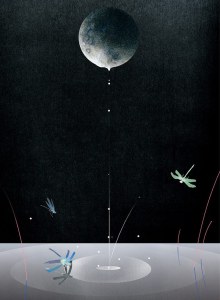
The story’s illustration is by Linda Yan. I love it because it reminds me of early 20th century sheet music.
Two relevant contexts (relevant to me as I wrote—possibly not to someone reading):
1.
I like songs that only become folk music as they are repeated, gradually coming unstuck from their original authors. “Now is the Hour” was popularized by Gracie Fields after the Second World War—one of those songs of longing and separation that seemed so popular in those years. The melody was written by a theatre critic called Clement Scott and called “Swiss Cradle Song” until a Maori woman named Maewa Kaihau wrote the now-familiar words and renamed it “Po Atarau” and then “Haere Ra Waltz Song.” In the song’s global wandering it lost its original attribution, which is why Gracie Fields called it a “traditional Maori song” when she heard it in 1945.
“Wildwood Flower” started out as sheet music in 1860 with the title “I’ll Twine Mid The Ringlets,” but by the time the Carter Family recorded it in 1928, it was folk music—attributed only to “trad” until AP Carter got a writing credit when the work was republished after its success.
2.
Ernest Seitz was a Canadian composer. He trained in Berlin before the First World War, but returned to Canada in 1914 for obvious reasons. While he devoted his life to teaching and concert performances, he’s probably most famous for a song that doesn’t have his name on it—“The World is Waiting for the Sunrise.” He was, according to some stories, embarrassed to have written a pop song. Nevertheless, it captured the imagination of so many performers: Fritz Kreisler to The Beatles, and Oscar Peterson to Neko Case.
Did he ever enjoy that remarkable accomplishment? Did he ever hear one of these versions on the radio and think that’s mine?
Lackington’s published a story of mine in their last issue. It’s called “The Glad Hosts” and is one of several stories and images Ranylt Richildis selected to explore “Skins” as a theme. It is, according to readers, a piece of parasite body-horror.
I say “according to readers” because while I wrote the story because I’m curious about parasites, I did not consider it body horror until I saw the responses. Yes, it describes the transformation of a woman’s bodies in multiple ways, but horror?
After the issue went live, a friend of mine posted a link to a metafilter discussion which included a series of insightful and amusing responses that indicated yes, I had written a horror story while I thought I was writing a story about transformation and distance and family.
(I particularly liked this one: “Are there parasites around that will remove this story from my brain because it was horrifying?” from jeather)
Since then other people have responded in equally interesting ways. At Marooned Off Vesta there’s an extensive and considered discussion about free indirect narration and what it does to storytelling, as well as some good points about the challenges of authorial self-consciousness. Charlotte Ashley over at Apex makes some interesting observations about what the story says about subjectivity. There are similar points over at Susan Hated Literature, which suggest it’s a story about the limits of such subjectivity, and where (exactly) we locate the self.
This is all less about “The Glad Hosts” than it is a reminder to me that while my writing life is spent mostly alone doing work that is invisible and unread, there are actually people out there who might catch a story at the right moment and read it and respond. This makes me very happy because it makes me part of a conversation. And it leaves me feeling lucky, too, that Lackington’s exists as a place for us to meet up.
I really didn’t want Where is Here? to turn into a Bunch of Links About That Book I Wrote, though that seems to be where it’s headed these days. Not forever, I hope. I went to the Bicentennial “celebrations” for the Battle of Fort York last weekend, and I had a lot of thoughts, but they’ve mostly bypassed the blogging stage and leapt straight into the chapter about The War of 1812.
So, instead of my peculiar “insights” into military commemoration in Canada, here are some links about that book I wrote! It was officially out yesterday (I confirmed this through a visit to the bookstore. It’s definitely and for realsies out now) and it has collected two reviews:
Laura Frey at Reading in Bed says some really smart things.
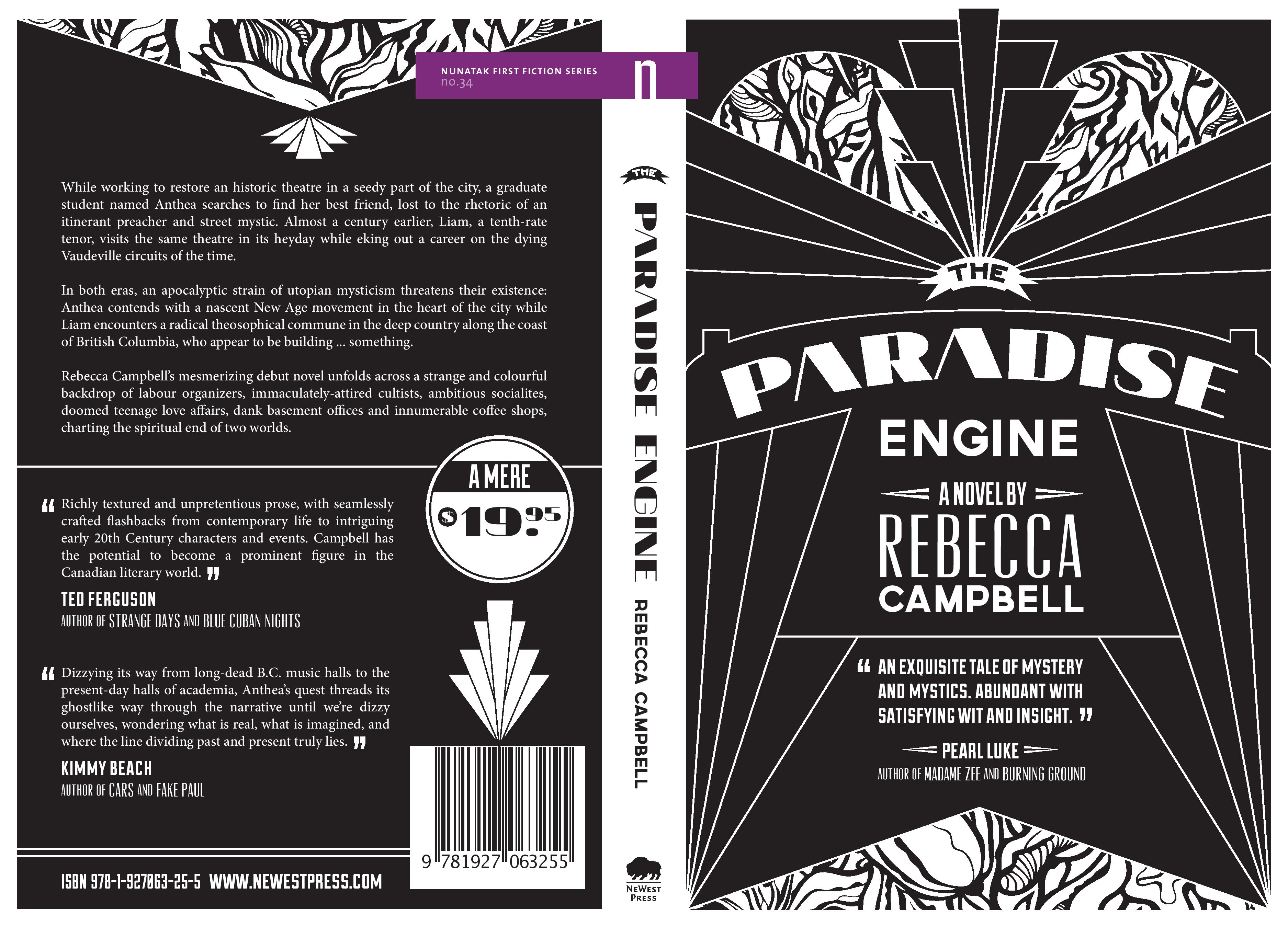
The Paradise Engine by Rebecca Campbell. Forthcoming from NeWest Press May 2013.
So. Nearly four months away from this blog, which makes me sad, because I really like blogging. I spent most of the winter swamped in the innumerable, seemingly-unfinish-able tasks that dictate how and where I spend my time. That means either marking, or writing academic stuff. In happy news, I’ll be presenting a paper on Insurgency & Commemoration at Batoche for CACLALS this spring, at UVic. I haven’t presented a paper since 2011, so it’s about time.
I’m teaching an extra section of composition, too, for January – April, which means I have 70 students instead of the 30-something I had in the autumn. For the most part this is good news (for four months we’ve cracked the poverty line!) but it means I have no time. And so much to do. I try not to do the infernal mathematics: 70 students x 12ish assignments each = what was I thinking.
Of course, there are bright things, too, and pleasant news. One of them is that my novel is coming out in May. It has a cover! It’s very very pretty. I feel so lucky that the people at NeWest— editors, designers, marketers, managers– understand what I was trying to do, and have designed something that reflects & expands on the story. I’ve been thinking a lot about collaboration for the last couple of weeks, as I realize how many people have contributed to turning The Paradise Engine from a secret word document I kept squirreled away on my harddrive, to an actual, real book. That’s pretty exciting.


 Where is Here?