I recorded a wonderful short essay about a Christmas tree for this podcast, which collects all of le Guin’s blogposts. It was a joy, and it prompted me to binge-read her thoughts. Now you can listen to the “The Tree” at In Your Spare Time.
“The Floating Republic” over at Clarkesworld
New novella out today. It’s called “The Floating Republic” and it’s almost a space opera, about people stuck on a tiny mining colony for decades while a very long, pointless war rages all around them. As with a lot of my work, it owes something to Canadian literature, particularly the journals of fur traders in the Hudson’s Bay Company and the Northwest Company, trying to make sense of a world radically different than the one to which they were born. The novella is also about the second generation of settlers– those born far from a “home” they have never seen, and how they try to imagine belonging. You can read it here.
The Other Shore: Reviews

The Other Shore officially releases tomorrow.
Over at Calyx, Jan Priddy writes, “Rebecca Campbell […] sometimes leads readers gently into the hearts of troubled and lost souls, sometimes pushes us with ferocious energy into terrifying futures.”
Publisher’s Weekly gave it a star (this is important. we like stars) writing, “[t]his thought-provoking, wide-ranging collection stuns”
Over at Locus, Gabino Iglesias calls the book “the literary version of listening to a concept album.”
In the British Columbia Review, Dana McFarland writes: “Diverse in subject, time, and character, the stories feature places of the Pacific Northwest—as presence or genius loci more than mere setting—and reflect the limits of personal agency to reconcile with landscapes that are altered or altering beyond the capacity of any individual to influence. “
The Other Shore & Coming Home
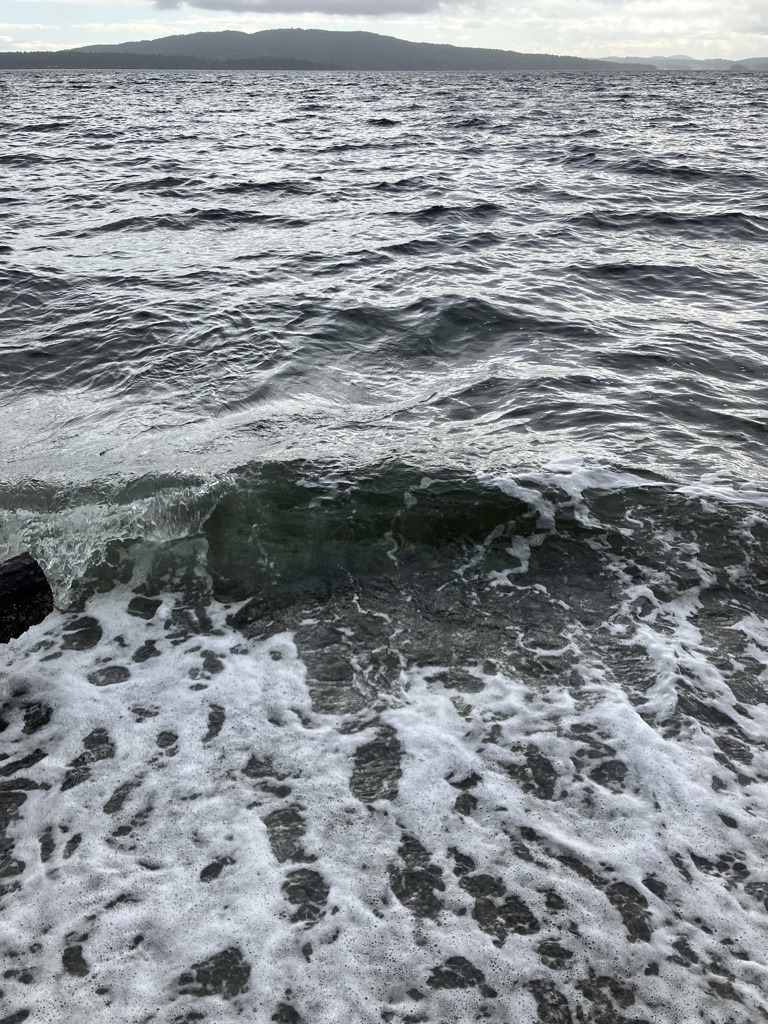
I’m writing this post from Saanich inlet, a place that’s in many of my stories, whether I name it or not. We’ve moved back to the west coast, and it’s strange how quickly Ontario has fallen away from me. We’ve been here a little more than a month, and in that time I’ve had moments of uncanny recognition, so intense they’re almost painful: in the drizzle, eating a spartan from the tree by the door while smoke from the chimney drifts down; low tide in the rain; cedar sawdust from the planer in my hair and eyes and down the back of my shirt (and in my socks); blackberries in sunshine; arbutus bark curling down to the forest floor; rain on the roof and waves on the gravel below the bedroom window.
Most of the stories I have written in the last ten years have been about exile and distance and leaving places behind. I wonder what I’ll write now that I’ve come back?
And in a nice synchronicty, my first collection of short stories is forthcoming from Stelliform Press. It was a struggle to select which stories, to find some kind of through-line across genres and eras. It starts in the past and ends in the future, and each story touches upon the place where I’m writing this: the north Pacific coast of North America. The Salish Sea. Home.


Aus dem Kanadischen Englisch
Today I got the German translation of Arboreality. It’s a lovely little hardcover, translated by Barbara Slawig, and published by Carcosa press. I’m particularly excited that they identified it as “Canadian English,” and I was grateful for her sensitivity to local names and words. When she asked, I got to explain a tiny little bit about Chinook Jargon, and that always makes me happy.

Arboreality Won The 2023 Ursula K. le Guin Prize
You can read about it here.
“Arboreality is a eulogy for the world as we know it. Rebecca Campbell’s extraordinary, deeply felt book explores the difficulties of the long hard project of survival. There are no heroes or villains here—only people making brave, difficult choices, out of hope and love for their community, for art, knowledge, and beauty. Arboreality imagines things that we haven’t yet considered about what can and will go wrong with our gardens, libraries, and archives if we don’t act now (maybe even if we do). In her masterful and profoundly ethical stories, Campbell asks us what might be saved, what must be saved, and what it will take to do so. ”
Ursula K. Le Guin Prize Selection Panel
Ursula K. le Guin Prize

I haven’t kept a good record here of what’s happening with books. I missed posting about The Talosite‘s publication last autumn, and about appearing at GritLit in spring, or about how Arboreality was nominated for the Philip K Dick Award in January (it didn’t win). But right now. Arboreality is one of nine books on the shortlist for Ursula K. le Guin Prize, and it has not yet not-won (the ceremony is in October).
It will surprise no one that Ursula le Guin is a huge part of my mental landscape, up there with Twin Peaks and Middlemarch and all the Tennyson lyrics I still have memorized. It’s not even about having a “favourite author” so much as it’s the two-by-fours that make up the walls of your brain, or the concrete underneath those walls. Her work is foundational. And now a book of mine is in this tiny way associated with her. It seemed important to write that down in public and remember it.
Arboreality Published
Last weekend I was at Word on the Street Toronto‘s pop up event at Evergreen Brickworks, where I got to walk through an old industrial site and talk about climate change fiction, and read from Arboreality. I also signed a stack of The Talosite for Undertow Publications, so I met my editors and publishers for the first time.
It was a good afternoon. Our walk was interrupted by rain pouring down on the corrugated roof, which is a beautiful sound that also required me to shout when I was reading from the novella. But my audience was patient and afterward I chatted with a few of them, talking through the tension between hope and dread that defines so much climate change fiction.
And now Arboreality is out in the world, full of hope and dread and officially available for sale. And I can’t quite believe it.
Preorders for The Talosite and ConQuesT 53
Two things:
First, Undertow Publications has a preorder page set up for my forthcoming novella, The Talosite. It’s historical SF/horror, describing death and resurrection on the western front of the First World War. I wrote about it in an earlier post and included some of the art I looked at while writing, if you want to see a little more of the world in which it takes place.
Second, I’m going to be at ConQuest 53 in Kansas City next week if anyone wants to come and say hello. I’ll be talking about weird fiction, body horror, climate change fiction and on other things on a couple of panels.
Arboreality 2022
Stelliform Press is going to publish my novella, Arboreality this autumn. It’s an expansion of my novelette “An Important Failure,” which was both challenging and wonderful. I got to return to characters and places I love, and explore the possibilities of a world that’s falling apart. Because new things grow out of the crumbles, don’t they? After the wild fires, the fireweed. “An Important Failure” was about a craftsman trying to preserve something precious while the world changed around. Arboreality has a few characters like that, but also characters who are picking up the remnants and making them into something new.
Stelliform publishes fiction about climate change that rejects apocalyptic visions– or visions that are exclusively apocalyptic. Their mandate is hope, and they celebrate resilience, both ecological and human. And not just resilience, but the ways we might all flourish in a re-made world.
I admire this. Having grown up on the nuclear apocalypses of the 1980s, where destruction was absolute and doom inevitable, it is a welcome challenge to write hopefully about the future, and to use the tools of speculative fiction to imagine beauty. I want to be a good ancestor, and to write about people who resist despair (even if they, like me, are inclined toward gloom). Arboreality is about the small ways we might be good ancestors, leaving tools and messages behind for people we won’t ever know, in a world we can’t imagine.
Like a lot of my work, the novella is set in the Cowichan Valley. It’s about people and trees: the Garry oak savannahs of the southern Salish sea, arbutus trees growing out of the rocks around Saanich inlet. My mother is a painter, and she’s been studying these trees for her whole adult life, leaving a record of these marginal landscapes, narrow ecological niches that are easily disordered, and so very beautiful. These are some of her paintings of Arbutus menziesii on the south coast of Vancouver island. Arboreality takes place under these trees, and on these rocks:


