The Other Shore: Reviews

The Other Shore officially releases tomorrow.

Over at Calyx, Jan Priddy writes, “Rebecca Campbell […] sometimes leads readers gently into the hearts of troubled and lost souls, sometimes pushes us with ferocious energy into terrifying futures.”

Publisher’s Weekly gave it a star (this is important. we like stars) writing, “[t]his thought-provoking, wide-ranging collection stuns”

Over at Locus, Gabino Iglesias calls the book “the literary version of listening to a concept album.”

In the British Columbia Review, Dana McFarland writes: “Diverse in subject, time, and character, the stories feature places of the Pacific Northwest—as presence or genius loci more than mere setting—and reflect the limits of personal agency to reconcile with landscapes that are altered or altering beyond the capacity of any individual to influence. “

Aus dem Kanadischen Englisch

Today I got the German translation of Arboreality. It’s a lovely little hardcover, translated by Barbara Slawig, and published by Carcosa press. I’m particularly excited that they identified it as “Canadian English,” and I was grateful for her sensitivity to local names and words. When she asked, I got to explain a tiny little bit about Chinook Jargon, and that always makes me happy.

Arboreality Won The 2023 Ursula K. le Guin Prize

You can read about it here.

“Arboreality is a eulogy for the world as we know it. Rebecca Campbell’s extraordinary, deeply felt book explores the difficulties of the long hard project of survival. There are no heroes or villains here—only people making brave, difficult choices, out of hope and love for their community, for art, knowledge, and beauty. Arboreality imagines things that we haven’t yet considered about what can and will go wrong with our gardens, libraries, and archives if we don’t act now (maybe even if we do). In her masterful and profoundly ethical stories, Campbell asks us what might be saved, what must be saved, and what it will take to do so. ”

Ursula K. Le Guin Prize Selection Panel

Arboreality Published

Last weekend I was at Word on the Street Toronto‘s pop up event at Evergreen Brickworks, where I got to walk through an old industrial site and talk about climate change fiction, and read from Arboreality. I also signed a stack of The Talosite for Undertow Publications, so I met my editors and publishers for the first time.

It was a good afternoon. Our walk was interrupted by rain pouring down on the corrugated roof, which is a beautiful sound that also required me to shout when I was reading from the novella. But my audience was patient and afterward I chatted with a few of them, talking through the tension between hope and dread that defines so much climate change fiction.

And now Arboreality is out in the world, full of hope and dread and officially available for sale. And I can’t quite believe it.

Arboreality at Stelliform

Arboreality at Amazon

Arboreality at Kobo

Arboreality at Goodreads.

Preorders for The Talosite and ConQuesT 53

Two things:

First, Undertow Publications has a preorder page set up for my forthcoming novella, The Talosite. It’s historical SF/horror, describing death and resurrection on the western front of the First World War. I wrote about it in an earlier post and included some of the art I looked at while writing, if you want to see a little more of the world in which it takes place.

Second, I’m going to be at ConQuest 53 in Kansas City next week if anyone wants to come and say hello. I’ll be talking about weird fiction, body horror, climate change fiction and on other things on a couple of panels.

Arboreality 2022

Stelliform Press is going to publish my novella, Arboreality this autumn. It’s an expansion of my novelette “An Important Failure,” which was both challenging and wonderful. I got to return to characters and places I love, and explore the possibilities of a world that’s falling apart. Because new things grow out of the crumbles, don’t they? After the wild fires, the fireweed. “An Important Failure” was about a craftsman trying to preserve something precious while the world changed around. Arboreality has a few characters like that, but also characters who are picking up the remnants and making them into something new.

Stelliform publishes fiction about climate change that rejects apocalyptic visions– or visions that are exclusively apocalyptic. Their mandate is hope, and they celebrate resilience, both ecological and human. And not just resilience, but the ways we might all flourish in a re-made world.

I admire this. Having grown up on the nuclear apocalypses of the 1980s, where destruction was absolute and doom inevitable, it is a welcome challenge to write hopefully about the future, and to use the tools of speculative fiction to imagine beauty. I want to be a good ancestor, and to write about people who resist despair (even if they, like me, are inclined toward gloom). Arboreality is about the small ways we might be good ancestors, leaving tools and messages behind for people we won’t ever know, in a world we can’t imagine.

Like a lot of my work, the novella is set in the Cowichan Valley. It’s about people and trees: the Garry oak savannahs of the southern Salish sea, arbutus trees growing out of the rocks around Saanich inlet. My mother is a painter, and she’s been studying these trees for her whole adult life, leaving a record of these marginal landscapes, narrow ecological niches that are easily disordered, and so very beautiful. These are some of her paintings of Arbutus menziesii on the south coast of Vancouver island. Arboreality takes place under these trees, and on these rocks:

Eligibility: What I Published in 2021

I had two stories out this year.

The first appeared in the March/April The Magazine of Fantasy and Science Fiction. “The Bletted Woman” is a story of material transformation and the intimate effects of climate change on our microbiome. It’s about re-imagining death not as a spiritual shift, or an absolute ending, but as a physical transfiguration. So, you know, a super cheerful story.

The second appeared in the November issue of Clarkesworld, a novelette about the fears of parenting and different sorts of not-exactly-linguistic communication. It’s called “The Language Birds Speak.” If you’re going to read it, I suggest you listen to Kate Baker’s excellent audio version (available here and over at youtube), since the story plays with communication and the power of sound.

It’s been a long, sad, exhausting year. I hope you’re all well and safe.

“The Language Birds Speak”

I have a new novelette in the November issue of Clarkesworld: “The Language Birds Speak.” It’s about parental anxiety. And communication. And the way having a child changes the way you understand your own childhood. I started this story when my son was an infant, so three or more years ago, but only finished it in September and it’s another attempt to describe the strange mental transformations of motherhood. It’s also about children, too, and the neurological consequences of neglect, which I read about while my son was in utero. In those months I learned that we are creatures of collaboration: that we quite literally create one another as we interact. The hormonal changes of pregnancy transformed my brain. All the songs and cuddles and nose-boops of babyhood changed my son’s brain, too.

She’d been bent over a smartphone, absorbed, her face unresponsive. He’d been six months old, dozing in her lap, and seen that blank nightmare mask of a mother. Her disregard had permanently scarred him. The core trauma of his life already underway and unstoppable: parents so busy with their work and themselves that he, little visitor, found himself too often alone, a social animal in unnatural isolation, like an orca in a tank at Sea World. Or a rhesus monkey snatched from his mother and consigned to the stainless-steel pit of despair, surrounded by nothing but the distortions of that mirror, the reverberating cries of his isolation. For science.

“The Language Birds Speak”
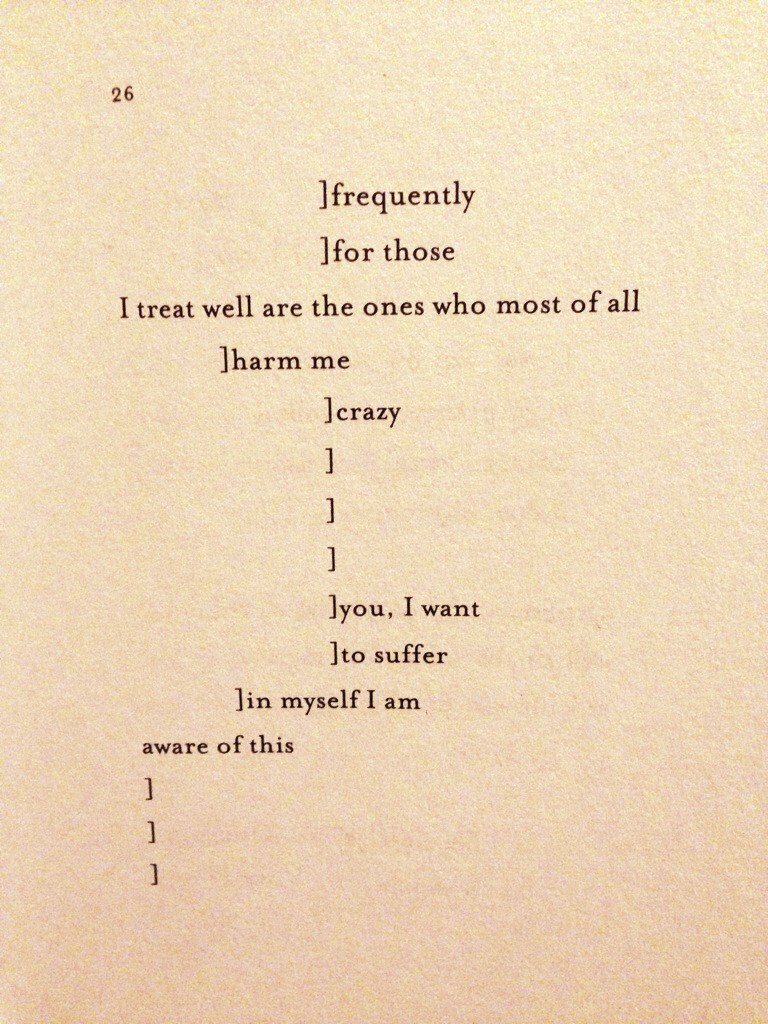
I borrowed this from @vilmastuttle on twitter. I love this page– what it says, and what is lost to us in all the white space

The story is also about how we process sensory information, or fail to process it, or ignore it. It’s the most I’ve ever written about misophonia, and the terrible skinlessness I can feel when my senses overload. It’s about instinct and insight, too, and about fear.

But it’s hard to write about any of these things– the first wordless communications of infancy, the painful brain-overload of misophonia–through language, since the whole point of the story is that profound experiences resist language. I kept thinking of incompletely-remembered French feminist theory from undergrad, especially Julia Kristeva’s “the Semiotic.” The idea that meaning and language don’t exactly intersect, and that communication is far more elusive than black words on a white page. The idea of an original, divine language: Enochian, Adamic, the language birds speak.

The answer lay not in theory, but in poetry. For years I have loved Anne Carson’s translation of the Sappho fragments, If Not, Winter, not only for the words on the page, but also for the way she represents absence in her text, using square brackets [ ]. Framing the white space that way gives me such a wonderful, thrilling sense of possibility, that meaning spreads out from the words that survive, rather than being limited to them. That’s where I found the tools I needed to write this story.

“An Important Failure” wins the Theodore Sturgeon Memorial Award.

“Campbell Wins Sturgeon”

Back when I was a kid who read everything, there are two places I spent a lot of time: the Duncan branch of the Vancouver Island Regional Library, where the YA section was full of Andre Norton and Edward Eager; a used bookstore in Duncan run by an old guy who liked cats, potted plants, and magazines published by the Canadian Marxist-Leninists. I was unpacking books this week, to put them on our new shelves, and I found paperbacks with his distinctive handwriting in them, and a unicorn stamp. The prices were low: I got all my John Wyndham paperbacks for 50 or 75 cents. Same with my Ursula le Guin short fiction collections, and my Nancy Mitford novels, and lots of modernist poetry. It was rich in there, dusty and full of cat fur, and you came out a little wheezy, but it was a good place to search while your Mom looked for Elizabeth Gaskell novels.

Anyway. Among the books I bought there was The Science Fiction Hall of Fame, Volume 2A which contains “Baby is Three” by Theodore Sturgeon. I loved that story.

It’s strange to find your name associated with all those writers you once uncovered in a bookstore, or on a library shelf. I make up stories while staring out the window, or lying on an old couch while my kid makes LEGO rocket ships on the floor. It’s difficult to believe that’s as “real” as anything I found in that bookstore, or at the library. But here we are.

The Talosite Will Arise in September 2022

Last month I signed a contract with Undertow Publications for my novella The Talosite. There’s a lot of work still to do, but I know that in the end it will be a beautiful book because that’s what Undertow does.

The Talosite is about the First World War. It’s not like my earlier work on the subject: not academic, nor a literary novel about a vet who becomes a vaudevillian, nor a fantasy about the Belgian Mundaneum in August 1914. This time it’s unapologetic body horror.

For good reason. The First World War has been a kind of intellectual touchstone in my life for decades, but my sense of it is not intellectual. It’s visceral and impressionistic, like poetry. It’s an undifferentiated landscape: living/dead, past/future, modern/antimodern, liquid/solid, interior/exterior, subject/object are blended into a single substance, seething and amorphous. From this materiel without distinction,The Talosite arises, full of characters navigating the physical and political chaos of the western front, which consumes the bodies of the living as Saturn devoured his children. And– it’s not exactly a spoiler– regurgitates them again.

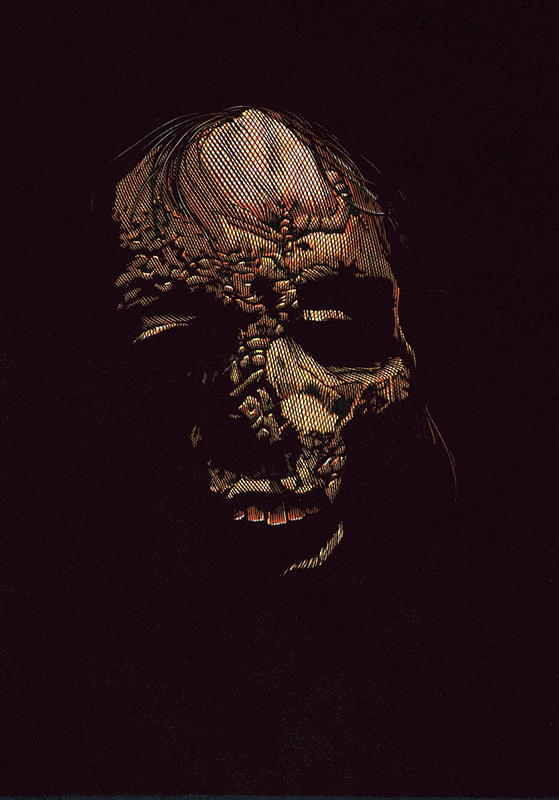
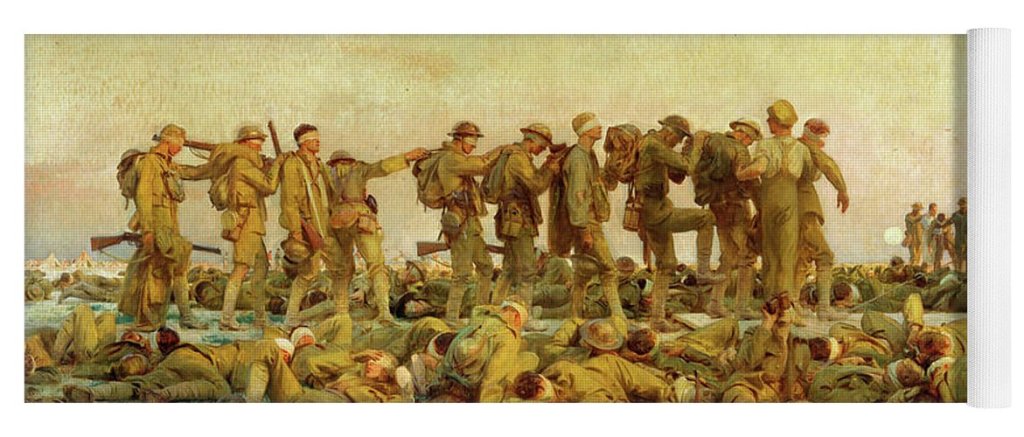
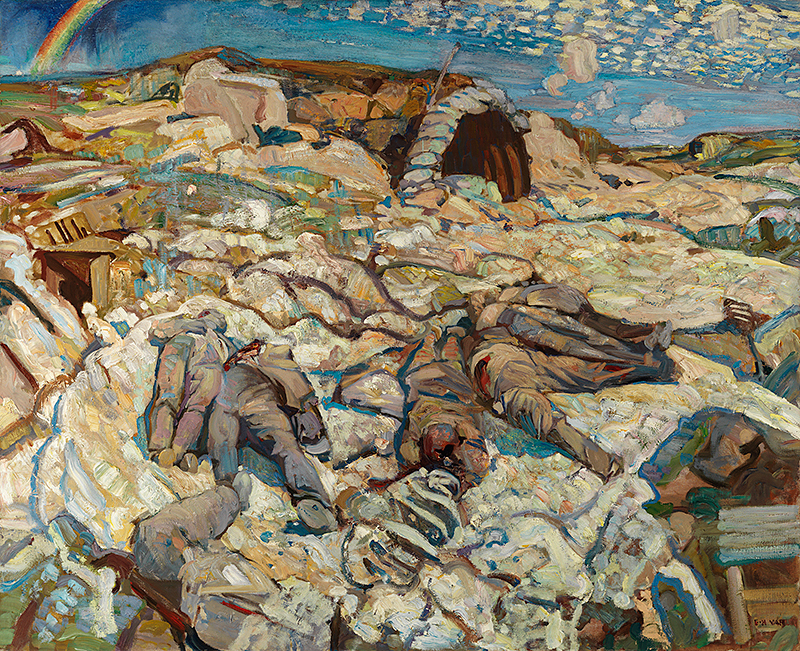
I collected a lot of images for this one. Woodcuts for a 1934 edition of Frankenstein illustrated by Lynd Ward. Images from 1983 by Barry Moser. The Gueles cassées of the western front, horrifying not only because of the pain they witness, but because the most private interiors of their bodies are visible on the outside. When a friend of mine was working on a collection about James Bond, she showed me photographs of Rodin’s walking man, who is headless and armless but still walking, the seams showing where he was re-assembled from other bodies. I looked at Otto Dix’s post-war prints, and Sargent’s horrifyingly lyrical Gassed. Fred Varley’s The Sunken Road, a landscape with little distinction between body and earth.